Pages

Friday, 11 March 2011

Desperate illustrator?

Dear illustrators, or aspiring illustrators, if you're ready to worn out the soles of your shoes along the corridors of the Bologna Book Fair, looking agonizingly for a publisher/art director/professional illustrator whom to show your works to, today, for you, there are good, better


EXCELLENT NEWS!

A real task force composed by professional illustrators, upon whose identity remains a deep mystery, have decided to be at your disposal, how?!? Well, read here and rejoice:


No Book will be Neglected
BOLOGNA CHILDREN'S BOOK FAIR 2011

Dear friends, colleagues and editors,
it's several years now I started having the feeling that, for those who are moving their first steps in the world of children's books illustration, there are less and less chances during the Bologna Book Fair to show their work, to receive advices and, why not, solemn harsh criticism (that are always useful).
This is not the moment to discuss the reasons for it: there is much to do, everybody is tired, there's no time to concentrate.
It still remains true that those guys need a first contact with professionalism and some advice.
Even if natural selection – bringing ahead not simply those illustrators that are the more talented from the technical point of view but also those who are able to get by in the complex world of publishing – has some sense, I believe that a minimum availability for young illustrators is a duty, for those who made it, more than being something that can reveal to be useful, not just for them.

The CMYK Project is a group of superheroes, or professional illustrators and authors whom, during the fair, have accepted to be available for younger illustrators to take a look at their books.
There is no established meeting, no place where they can show and queue up.
Our four can be recognized by a pin and a badge. If you see them, you can simply stop them and open up your book.
The four superheroes in this group are:
Mr. BLUE – MAGENTA - Mr. BLONDE - Mr. BLACK

One only request:  if Blue, Magenta, Blonde and Black aren't showing their badges exposed here below it means that they are NOT available, in that moment because otherwise busy.


please do respect this simple rule.

A sincere THANK YOU, for this generous and brilliant idea is the least thing I can say! 

This whole thing makes we wish to give chase to them, my camcorder at hand, ready to capture any sign, in alert looking for suspicious jams in the corridors, of wary cliques scattered in the less obvious corners. To be in theme I shall wear a mask too... well, if I think of it I'd better not: the only one I have is a cat's mask, remains form carnival, which makes me certain that I would unavoidably be mistaken for Garfield!!! Mumble, mumble, mumble... what shall I do? Well, I'll think of it!

Anyway:

THANK YOU GUYS, YOU'RE OUR HEROES!

Tuesday, 8 March 2011

FESTIVAL MINIMONDI - XI Edition 12th-27th March

It's about time: Festival Minimondi is back!!!


Once again Parma turns cultural thanks to the eleventh edition of the famous festival, devoted to literature and illustration, that will run from March 12th to 27th.

Like in past editions, the festival's program is extremely varied, in fact amid other events there will be: the fantastic Remy Charlip exhibit, several workshops and events with authors and illustrators, and with Editoriale Scienza, meetings at schools, workshops with Focus Pico about graffitis and artwork with plasticine, a season of films at Cinema D'Azeglio and the always actual initiative Adopt a Publisher.

Amid the guests: Brunella Baldi, Viorel Boldis, Francesca Capelli, Ennio Cavalli, Anna Cerasoli, Roberto Denti, Ermanno Detti, Miriam Dubini, Silvana Gandolfi, Antonio Nicaso, Giulia Orecchia, Chiara Rapaccini, Gustavo Roldan, Silvia Roncaglia, Andrea Salvatici, Guido Sgardoli, Iole Severi Silvestrini, Tabitha Suzuma, Virgilio Sieni, Vanna Vannuccini, Guia Risari.


I would like to focus your attention on one event, to my opinion, unique: the exhibition 


REMY CHARLIP DANZARE IL MIO LIBRO*

that will run from March 12th to April 25th at Galleria San Ludovico**. The show has been organised by Festival Minimondi and edited by: Les Trois Ourses, Associazione Minimondi and by the architect Marco Ferreri, who is responsible as well for the setting up.

First of all this is the first italian show devoted to the American artist in its whole, that is to say a one-man exhibition including his activities as illustrator, author, choreographer and dancer as well, it's therefore a unique occasion that you shouldn't miss.

Charlip is a really extraordinary character, who has lived a very interesting life: choreographer and dancer as I said he collaborated, for about 12 years, with the company of the legendary avant-garde choreographer Merce Cunningham. Though, during his career in the world of dance, he never stopped writing children's books, because: "I have always wanted to do picture books for children"***. From the beginning of the fifties, Charlip has published more than 30 titles of which the last, A Perfect Day, dates 2007. As he declared during a celebration dedicated to him in '97, from Library's Children's Literature Center Convention, he loves changing style and experiencing new languages and perspectives, in order to better represent a variety of situations: "How I look at subjects, people and things are different, so I like to bring that to the books"***

To give voice to the multi- artistic soul of the American author, the exhibit has been set up by dividing the main central room, where the first editions of his books will be showcased together with original artwork from his books, from lateral niches where didactical activities will take place and where videos with Charlip's performances as dancer and choreographer will be shown.

In the context of Charlip's activity in the world of dance, on March 14th at 06.00 p.m., Virgilio Sieni will execute the performance titled "Stanze, accenni e sguardi sul corpo come luogo”**** dedicated to Merce Cunningham, who was one of his teachers.

Amid the many interesting documents of the show there is as well a letter from Bruno Munari, dated 1958, where he congratulates Charlip for his book It looks like snow and, meanwhile, sends him a mock-up of his book Nella nebbia di Milano. It's nice to realize how culture grows always richer when it opens up, letting experience flow through communicating vessels that make it wider. In this case our communicating vessels are human relationships and the ability to open up to exchanges: in 1981, Munari dedicated Charlip (and John Cage) his Cappuccetto Bianco**** for those who know both texts the reason is quite evident.

Of Charlip's many books, il Italy only two have been translated: Niente, published on 2007, and Fortunatamente, that has just been published, both texts were published by Orecchio Acerbo. Fortunately is as well the 100th title of the roman publisher that celebrates its 10th anniversary this year.

One last curiosity: writer Brian Selznick has the merit to have made Charlip famous in the world, in some case way before his books were translated and published, because he got inspired by Charlip's features for the character of Georges Méliès, in his book La straordinaria invenzione di Hugo Cabret (The Extraordinary Adventure of Hugo Cabret).

In short: don't loose this occasion!


For more information you can contact the following:

e-mail: info@minimondi.com
website:     http://www.minimondi.com/
telephones: 3287826571 - 3208112085 - 3487334761


*REMY CHARLIP DANCE MY BOOK


**Galleria San Ludovico is in Borgo del Parmigianino 2/b, Parma. It's opened from 09.30 a.m. To 06.30 p.m., it's closed on Tuesdays.

*** Both mentions were taken from the article: "Young at Heart: A Celebration of Remy  Charlip", published in the Library of Congress LC Information Bulletin, June 23, 1997.


Image Copyright© Orecchio Acerbo Editore 2011, all reproduction is severely forbidden.

Tuesday, 22 February 2011

The winners of the 2011 BOLOGNA CHILDREN'S BOOK FAIR

Here are th book selected b the jury for the 2011 Bologna Children's Book Fair:


FICTION

ÉDITIONS MILAN - Toulouse, France
FABLES texts by Esope, adaptation by Jean-Philippe Mogenet, illustrations by Jean-François Martin


Special Mentions have been assigned to:

HYACINTHE ET ROSE, texts by François Morel, illustrations by Martin Jarrie, ÉDITIONS THIERRY MAGNIER - Paris, France

THE IRON MAN, texts by Ted Hughes, drawings by Laura Carlin, WALKER BOOKS - London, United Kingdom


NON FICTION

CHANGBI PUBLISHERS - Paju, Republic of Korea
A HOUSE OF THE MIND: MAUM texts by Kim Hee-Kyung, illustrations by Iwona Chmielewska


Special Mentions were assigned to:

CO Z CIEBIE WYROSNIE? texts and illustrations by Aleksandra Mizielinska, Daniel Mizielinski, DWIE SIOSTRY - Warsaw, Poland

THE STORIES SHOULDN’T BE TRUE, texts and illustrations by Gang GyeongSu, SIGONGJUNIOR - Seoul, Republic of Korea


NEW HORIZONS 
 
COSAC NAIFY – São Paulo, Brazil
MIL-FOLHAS – HISTÓRIA ILUSTRADA DO DOCE texts by Lucrecia Zappi, graphic design by Maria Carolina Sampaio


Special Mentions went to:

A JANELA DE ESQUINA DO MEU PRIMO, texts by E.T.A Hoffman, illustraztions by Daniel Bueno, COSAC NAIFY – São Paulo, Brazil

UN DÍA, texts and illustrations by Chiara Carrer, PETRA EDICIONES – Zapopan, México


OPERA PRIMA
 
ÉDITIONS MeMo - Nantes, France
MONSIEUR CENT TÊTES texts and illustrations by Ghislaine Herbéra


Special Mentions went to:

DIAPASON, illustrations by Laëtitia Devernay, LA JOIE DE LIRE - Geneva, Switzerland I had already told you briefly about this book here.

SŁONIĄTKO/FANTJE, texts by Adam Jaromir, illustrations by Gabriela Cichowska, MUCHOMOR - Warsaw, Poland/GIMPEL VERLAG - Hannover,Germany

 
You can find the jury's motivations and plenty of other information here.

Monday, 21 February 2011

The Wild Swans - Topipittori

The Wild Swans by Has Christian Andersen, illustrations by Joanna Concejo, translation by Maria Giacobbe, Ed. Topipittori, February 2011


Every time I open up a book illustrated by Joanna Concejo my wrists start shaking with emotion, for how deeply her images arrive to my heart with no filters nor inhibitions. It's beyond my control, an emotional wave overwhelms me entirely, leaving me breathless, as if the most beautiful and sad memories came out of their tidy drawers all at once and started dancing all over my body.

When I learned that Giovanna and Paolo, our Topi, had assigned her one of the most beautiful and difficult texts by Andersen I deeply rejoiced, and not because I'm sadistic: this was one of the stories my granny used to tell me more frequently and I couldn't wait to plunge into the interpretation Joanna would have given of it.

It's not easy to confront with a classic, least of all if the classic is signed Hans Christian Andersen, because the psychological complexity of his tales is heavy, because rendering his melancholic and poetical atmospheres is extremely difficult, because the harshness of his stories seems at times hopeless (I have vivid memories of the anguish I felt when, child, I read The Little Mermaid). Giving essence to such a refined and restless soul is not simple.


This tale, in particular, is extremely complex because it represents the fall from childhood's paradise towards the abyss that goes along with adolescence, between disenchantment and inability to communicate, between the loss of one's nearest and dearest and the desperate effort of bringing them back.

The main character, Elisa, is alone. Left to her own devices, every minute of her life is spent in the memory of her beloved brothers, that she will find again only almost adult, and of the nice moments spent with them. As in almost all traditional tales, advocate of the fall is the cruel stepmother who alienates the children from their father condemning them to an imposed silence, deriving from the mutation into swans for the sons and from the forceful separation for Elisa.


As suitable to an appropriate tale's hero, Elisa is at first a child and then a young woman of great virtues: beautiful, polite, with a firm faith, she places her and her swan-brothers' destiny in the hands of Divine mercy, scrupulously following the precepts she's being given without a doubt, with no sinking. Despite physical suffering, caused by the nettles she's obliged to spin to make the shirts that will break the witch-stepmother's spell, despite all the risks she runs, the young woman will bring her task to the conclusion assuring her brothers and herself the longed happy ending.


Joanna has given an amazing interpretation of this tale, full of symbolic cross-references and noble moments. Her illustrations reaffirm Elisa's loneliness in several ways, as it happens in the image here below, where the nettles form a sort of frame/prison that isolates the beautiful princess from the rest of the world:


Depicted from behind, bent on her own piece of work, the young woman looks like a twig bending over to life's moodiness: she doesn't address us while we observe her, she can't say a word, otherwise her brothers would die.

I would like to recall your attention on the first image of this post, on the mirror-image portraying the shape of a swan to be precise, because this illustration recalls with great strength the idea of presence/absence of the brothers: on the left side of the image the swan looks like a ghost, only vaguely sketched, and the little character in the distance, as big as a little speck, represents young Elisa wondering with no precise intent, looking for those she can feel without really seeing; on the right side nothing is left of the swan if not its negative, the silhouette, almost as if to remark the ideas of distance, unattainability, absence.


Absence, together with desperation for the impossibility of carrying on the task of weaving the eleven shirts, is recaptured in this image as well


where, to a more descriptive part where we can see tiny knights galloping towards the castle whose king has decided to take Elisa with him and to soon marry her, is powerfully opposing the image on the right, a portrait of the young woman, visibly hopeless, whose image is at times eclipsed by those embroidered disks, transparent, appearing as well in the flyleaves of the book. The presence of those objects seems almost to be emphasizing the sensation of emptiness that overwhelms the girl when she is parted from her brothers, her body is almost maimed, erased, at the same time the shape and the positioning in flock the illustrator gave those disks seems to be recalling the idea of travel and the temporary nature of the situation.


In the last illustration I propose, once again Elisa turns her back to us, once more she appears as the solitary hero, framed by the crowd that between fury and incredulity besieges her


Only favourable wardens the birds, observing the scene at a distance, as if to symbolize the benevolent glance of heavens.

To end with, please observe the wonderful harmony of Joanna's tables, drawn using pastels, their balance in the use of colour, the gentleness of her stroke.

Beautiful the translation by Maria Giacobbe.

This book doesn't cost "half of the kingdom", it doesn't even cost as much as Elisa's precious book therefore, if I was able to arouse your curiosity, I suggest that you to pay a visit to the bookshop (or to the publisher's website).


The book has been published simultaneously in french, for Editions Notari.


Copyright© text and images Topipittori 2011. Images have been reproduced with the permission of the publisher, all reproduction is strictly forbidden.

Tuesday, 15 February 2011

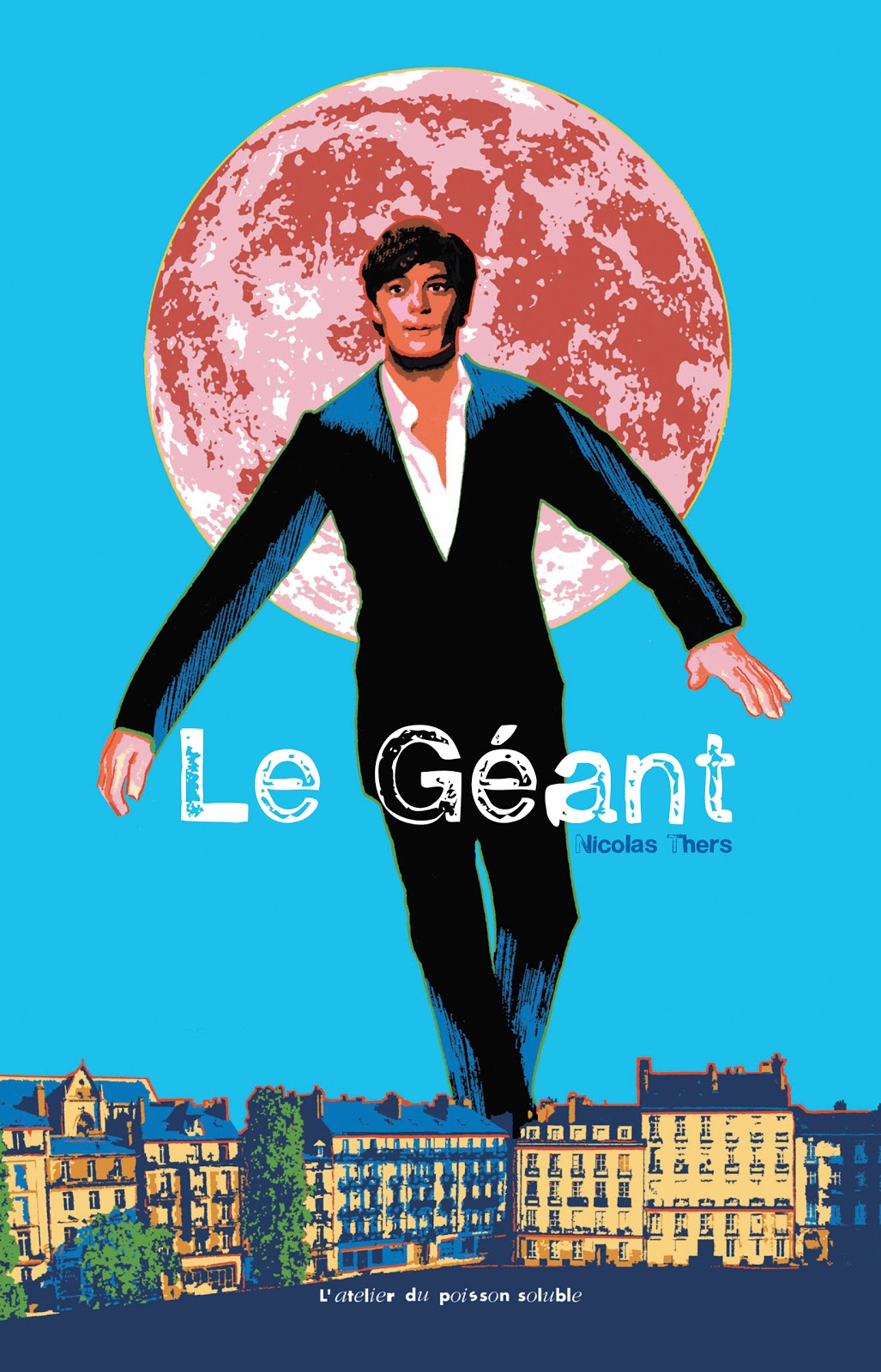
Le Géant - L'Atelier du Poisson Soluble

Le Géant by Nicolas Thers, L'Atelier du Poisson Soluble, May 2010


"Maman et moi avons décidé d’adopter un Géant! C’est mieux d’être trois pour regarder les étoiles."*

This is how the new book by Nicolas Thers - Le Géant, the giant, for the French soluble fishes - starts.

Title and cover already reveal a lot: the one that is portrayed is a giant that scarcely resembles the scary Polyphemus or Roald Dahl's bad giants, no trace of Rabelaisian’s memories are left with this tall titan, otherwise it's the businessman's, or the doctor's or the banker's aspect that dominates if ever. A real urban mastodon, in jacket and white shirt.

Though he is gigantic, no doubt!

When I first saw this book, I was completely blown away by the images, the use of colour and the quality of the images, quite unusual though totally convincing, really struck me. Visual impact was such that, at the very beginning, the message contained in the book became less evident.

Though I want to start talking of the message contained in the book, before analysing the images, because it deals with a subject touching many families, be them the result of a separation or of widowhood, which break up to then reset otherwise.

The narrator of the story is a girl telling how she and her mom decided to adopt a giant, exactly! It seems there are very good reasons to adopt a giant, and the explanation is abundantly detailed.


Of course, in the presence of such a tall being, feeling frightened and a bit suspicious as well is totally understandable, at least in the start but then, if the colossus is kind, if he offers us a few presents and showers us with attentions, if he allows us to explore him a bit and takes good care of us, then becoming friends is unavoidable.

I was really amused by how the author decided to expose this role game, giant/girl, where the third character - the mother - is nothing but secondary to the purposes of narration, as she only appears in the sentence I quoted at the beginning of the post and she is never represented in the images.

The whole book plays around the slow and constant approach between the two: of course images and text go completely along with the kid's vision emphasising her fears at first, that materialize in the representation of the giant's physical power while the girl is almost invisible (see the image above), to then illustrate the gradual acceptance of the man, that corresponds with the slow resizing of both characters until they reach a reasonable physical dimension (see images below).


The character's real dimensions recuperating process, with the consequent balance change in the original role game, develops through the slow and constant physical approach between the two: the girl, that at the beginning of the book was just a small coloured dot in the distance, gains more and more substance when she starts moving towards the giant, as if to affirm that the growth of a human being can take place only when he gets connected to the people around him.


As for the images, Thers had great fun playing with photomontage reworked with graphic palette, the colours are clear, simple, immediate. As I was saying before the tables are all centred on a skilful and audacious perspective game, their urban setting, almost futuristic, gives the images a touch of surreal that goes very well with the unlikeliness of the situation at the start. In a not too far future, giants will get out of their hiding places and will become mates and daddies.

A beautiful picture book, perfect identification with child's imaginary and positive résumé of the mechanisms hiding behind modern families.


* "Mummy and me have decided to adopt a Giant! It's better to be three to look at the stars."


Copyright© text and images L'Atelier du Poisson Soluble, 2010. Images have been reproduced with the permission of the publisher, all reproduction is strictly forbidden.

Tuesday, 8 February 2011

El Tren - OQO Editora

El Tren, by Silvia Santirosi, illustrations by Chiara Carrer, OQO Editora, February 2011

When Silvia told me her first book was about to be printed, together with the joy I felt as she was crowning such a nice dream, I immediately thought I would have had a nice surprise, and I was right. After all, I expected nothing less from someone as intense as she is.

In this poetic story, made even more profound by Chiara Carrer's marvellous illustrations, Silvia tells us about a difficult topic and she does so without choosing easy loopholes, on the contrary she undertakes the bristliest path, putting salt over wounds, showing in all its excruciating power the strength of sorrow: El Tren is the story of a child and her dad, the story of a trio left maimed for the loss of a vital part, the mother, the story telling of the attempt to fill an emptiness that becomes ruinous precipice.

A father and his daughter, alone, looking at the stars and a newborn bright dot, in the distance. A little dot that seems almost reachable, the hand stretching out in the emptiness. And then, in the silence of await, the voice of a child telling of a recurring dream: there's a train she must get, though, despite all effort, it leaves solitary leaving the disheartened girl on the empty platform.


In the alternation between the telling of the dream and acts of everyday life, we assist at the dissolution of pain, at the metamorphosis that makes ineffable more real and real less defined, maybe less definitive as well.
The father listens, patient, curious and defenceless at the same time, he feels all the difficulty enclosed in that repeated dream to which none of them can give an answer.

" Come posso dirti che le persone che amiamo muoiono, ci lasciano e vanno via?" * wonders the father. Maybe there's no way, maybe we should all find our own way, or maybe we could just tell another story, like the one of the blind man asking his neighbour to describe the colour white...


and in the act of sharing, everything might change once more


I particularly like the way the text renders the simplicity of a conversation between father and child, the way in which more simple gestures leave place to higher moments: without ever leaving behind the central subject of the book, the author allows us to share life passing by, imperturbably following its own rhythms and logics.

To my opinion Chiara Carrer's narration adds, weights up, moves, interprets this beautiful text sublimely. As I was saying above, the story is built on a double reading level, alternating dream and real, emotion and gesture, reason and feelings. To realize this difficult dichotomy, if we just take a look back at her other works we realize that Chiara has chosen an unusual interpretation (even if many germs of this last work can be found elsewhere as well): while real has a more graphic quality, dreamlike has a pictorial quality, here is an example


in the moment of dream, and from the psychological point of view in the moment of sorrow as well, the sign blurs to leave place to colour and its matter, the table is stained so as to become almost mark in order to give voice to all you can't explain otherwise; in the moment when the account starts again, the fogs of colour clear out in favour of a renewed sign.


All is revealed in the mirror-image above, turning point of image narration, because it represents the moment when dream and real touch for the first time: on the left the girl is represented while dreaming, we can understand she's about to wake up thanks to the more punctual definition of her silhouette compared to the previous image, on the right the moment when the girl questions her father about the meaning of the dream is represented. The identical pose of the girl, the reflected expression of emotions and pain narrated in this double image, the colour and its absence, all tells of a highly symbolic moment that flows into the absence of concrete answers and in the necessary absorption of reality.

From this moment on starts the father and daughter's route towards a new day...


a day when we shall just stretch out our hands to reach the stars we love...


I want to express my best wishes to this beautiful book, may it find place in many shelves, my congratulations to the publishers (as well) for their courage and for the professionalism they have in dealing with difficult themes, without ever drawing back.


* " How can I tell you that the people we love die, that they leave us and go away?"

Copyright© text and images OQO Editora, 2011

Friday, 28 January 2011

Monsieur 100 têtes - MeMo

Monsieur 100 Têtes by Ghislaine Herbéra, Editions MeMo, 2010


I already partly told you about this book here, it's the winner of the Prix Premier Album  obtained during the last Salon de Montreuil, debut book of the skillful Ghislaine Herbéra.

The making of this book, which is only apparently simple, unchains through the representation of Monsieur’s (the main character) moods. The narrative pretext, from which the psychological and cultural contents of the book derive, are built on the telling of an important day : Monsieur has a romantic encounter and he doesn't know which head to wear to cause sensation with his lady.


From that sort of magic cavern where he keeps his countless heads, Monsieur draws one head after the other, desperately looking for the perfect one. In a windmill of faces, we live all the different typical moods when the heart is in turmoil : shyness, frustration, anxiety, fear, joy, cheerfulness up to the happy ending.

Inuit Masks, Alaska

The text helps us understanding how easy it may be to pass from one mood to another: of how shyness can make us feel foolish and of how, when we feel foolish, we get hurt and anger grown uncontrolled and, when anger grows and we are able to do no matter what. After all, it's known, feelings master us despite our will.

The real brilliance and originality of this book, resides in the manner the author chose to represent those moods: in fact, the heads are masks coming from the whole world. (I do suspect that the masks might as well have been the starting point of the story but, for the moment, I have no evidence to demonstrate this). Amid others, there are masks pertaining to the theatrical and iconological inheritance of some countries: there's the Italian Comedy of Art, as well as the Kyōgen Theatre or the Nō Theatre (see cover image) from Japan, Ihamo Theatre from Tibet or the traditional mask used for the Dance of the Dead, during the Día de Muertos, in Mexico.

The book therefore becomes a cultural pretext, a tool through which we can discover the more secluded sides of the countries represented, gaining substance and evidence in their masks : ancestral expression – passing from idols to carnival masks, from popular tradition to the more cultivated one of theatres – masks have always been a sort of mean for telling of aspects forbidden by prevailing cultures as well as emblem of fears and sacred, passage from human to sacred, object of rituals and representations. From more clearly tribal allegories to the more refined ones, the reader is allowed travel through the book and to appropriate a precious heritage of information.


Bwa, Burkina Faso                  -                  Bengale, India

Going back to the illustrations, what immediately struck me of this book was the intentional cleanness of the images : the only colours evidenced are those of the masks and, at times, of the boxes where they are contained according to representative needs. Every object  contained in the illustrations has a precise aim, for instance : if, by looking at the first table, you assume that the object placed above the door in Monsieur's room is a simple showy decoration, then you will be soundly disavowed because, that one as well, is a mask. Just like the one on the very last table (I'm not telling more for obvious reasons !).

The scene looks bare, the double page is structured on the alternation of foregrounds aimed to highlight the expressions of the represented faces, in a flow with no apparent interruption. Monsieur, captured in the act of trying on the « head » of the moment,  is the thread that contributes to a narrative unicum flowing in the opposition, or consecution, of his various poses. The text, where present, is reduced to the essential. It's a simple skilfully played text, never banal, all played around increasing expectation and desire to discover what follows, that gives us the necessary information to make us feel in want for the next page.


Maltugi, Corea                   -                   Dance of the Dead, Mexico


A well structured picture book, sober, amusing, easy to read that I would suggest also to younger kids.


Copyright© images, Éditions MeMo 2010. Images have been reproduced with the permission of the Publisher, all reproduction being strictly forbidden.