I'm no big sports, I'm not even a supporter, and I don't like soccer.
I must say that I have no intention to hurt the feelings of those who, supporting a team put in this activity all the genuine passion they have. I'm convinced that many supporters, my father firstly, rediscover with soccer a mix of childhood memories and a rooted empathy with those eleven players (they're eleven, aren't they?) running after the ball for the 90 and more minutes of game.
Tonight I would like to let you discover a book that to me embodies the essence of sportive spirit: something that, to my very modest opinion, is slowly going lost in our country. I believe this is symptom of many other factors, that go way beyond soccer, and that would need a sociology treatise.
All I can do for you though, is tell you about this little masterpiece...
Goal, by Mina Javaherbin, illustrations by A.G. Ford, published by Candlewick Press (April 13th 2010)
As you can deduct from its cover this picture book is set in Africa, in South Africa to be precise. A group of kids from a bidonville plays a very concise game, always in alert, ready to defend their treasure: the ball. In those places where poverty reigns undisputed, a ball is a real treasure, as it represents a luxury: the luxury of playing, the luxury of being - for once - simply kids. The message of this book is strong, neat and illuminating. I believe that all children live soccer as a moment of pure joy, of aggregation, of game as simple as that, and this is even truer for those kids that have not much more than this.
I've never been a big fan of hyper realistic illustrations though, in the oil tables by A.G. Ford, there is something of definitely appealing, something I would dare call magic: for the ability in reproducing the character's expressions, for the sinuous movements, for the skill he has in recreate the atmosphere of tension and expectation typical of a match, the great sensitiveness with which he can represent a dignified poverty that never declines into obvious, into oversentimental.
For complete reviews I shall refer you to the following links:
the wonderful blog Seven Impossible Things Before Breakfast: http://blaine.org/sevenimpossiblethings/?p=1931 , where you shall find some beautiful spreads and a short interview with the author. And here you may find an interview with the illustrator.
I must confess that I too, as a child, have known the fervour of supporting: it was 1982, we had just won the World Cup and Sandro Pertini* was the bigger supporter. I remember I danced and screamed until I had no more breath left, I didn't know exactly what for, I had more the feeling I was possessed by some strange wild spirit, I felt like the lighting conductor of general excitement... though I remember it as a nice feeling, liberating.
* Former Italian President and partisan during World War II.
Today I have the pleasure to have a special visitor here at The Tea Box: Sara Gavioli, illustrator at her first publication with the publishing house Orecchio Acerbo. And I mean ORECCHIO ACERBO!
I met Sara in Bologna, during the Book Fair, and I immediately liked that slim figure, full of energy, hiding behind the wonderful illustrations of La Governante. If you'll ever meet her, don't be taken in by her appearance, Sara is an absolutely vigorous person and full of surprises.
But let's not lose any more minutes... it's question-time!
Let's start with some personal information:
- how old are you? 26
- you were born in? Carpi (Carpi is a small town close to Modena, in Emilia-Romagna, Italy)
- when you were a child were you a good reader?
At primary school I had an incredible teacher who made me love books from the very beginning; I therefore started reading very soon and a great variety of books.
- what did you usually read?
I literally devoured all of Bianca Pitzorno's books, Roald Dahl and Christine Nöstlinger, followed by the series of The Little Vampire by Angela Sommer Bodenburg.
- is there a book you still remember?
The first book I remember, probably because it was my favourite book at the time, is Trumpets in Grumpetland by Dallas-Smith Peter and Cross Peter (not to mention the series I Quindici*), as for novels I can say La casa sull’albero by Bianca Pitzorno. I remember I painted with utter care all the charming illustrations by Quentin Blake. I don't know why, but I imagined them in bright colours and I didn't like the idea they remained in black and white.
Let's talk about the beginning of your course in illustration:
- how did you discover your passion for illustration?
My passion started when I was very little: when I listened to my grandmother and my parents reading aloud I Quindici, I used to stare at the illustrations in enchantment. I still remember that peculiar smell the pages of these books had, I never found it again in any other volume, and this is why I keep sniffing all the books I hold in my hands.
- when did you understand you wanted to pursue this career?
Career is a big word, for the moment all I can say is that it's a very big passion. I kept being charmed by children's books: even when I stopped reading them, I kept looking for those sensations of pure pleasure I felt when I was a kid. I never really stopped drawing, I kept trying, even though I have to admit that I carried on with illustration almost by chance: I took illustration classes held by Eva Montanari, and then I said to myself "why not going on with this?"
- I know you followed an Illustration Master class, can you tell me something about it?
I obtained a First level degree Master in illustration with the Accademia di Belle Arti of Macerata in 2008-2009, the Master is organised by the cultural association Fabbrica delle Favole, , with whom I had already followed another course the year before. The Master**, that lasted one year, has the peculiar characteristic of alternating summer classes you need to attend, with winter classes that are held on-line, this allows working-students as well to follow, it is an attitude of great respect towards those people who cannot leave a job to follow their passion. Furthermore, the key point of the master is that it gives students the chance to confront with real editorial projects. In fact, every student receives the assignment of a book project from a publishing house, having thus the chance to undertake a real consignment.
- which was, if there has been one, the most difficult moment of the Master?
The hardest time has probably been the impact with the book's project: centring the characters is the spring that starts the whole mechanism of illustration, but it's as well the most frustrating moment. After an exhausting research, finding the right characters is a real conquest and an incredible satisfaction.
- how was the impact with the illustrators that taught you?
Having the chance to confront someone who is a professional illustrator is nothing but useful. I treasured their experience, and asked many questions! Being an illustrator means working alone in your studio, therefore having the chance to have an exchange becomes an occasion of growth. It's stimulating when you can observe the different points of view, the various techniques and the different stages of work of who already practises this job with excellence. And it's as well a very strange sensation when you can, finally, give a face to the stories you have been reading.
In-depth on illustration
- can you tell me if there is one, or more, illustrator that has particularly struck or inspired you?
Well, making a choice is really difficult, I can mention a few names like Quentin Blake, Arnal Ballester, David B, Marjane Satrapi, Elena Odriozola, Luci Gutierrez, Yoshitomo Nara, Riki Blanko but there would be many more.
- how about your favourite painter?
Another hard choice: Henri de Toulouse-Lautrec, Ingres, Dalì and Surrealists, Chagall.
- how does painting, and/or visual arts, enter your imagination? Assuming they do somehow...
I believe that all artistic expressions are a starting point and inspiration for something else. Photography, comics, sculpture, architecture, graphic, everything contributes to nourish your visual knowledge. A picture could become inspiration for a composition, graphics can be for colour combination, and a sculpture can become research for a particular shape. Personally, having a good visual memory, I can say that most often this reformulation happens unintentionally; illustration derives as well from the things you nourished it with, it is therefore influenced by all we have read and seen. A great teacher I had, Maurizio Quarello, particularly impressed me when he said: "Visit as many exhibitions as you can and you'll have done half of your work.”
- which illustration technique do you prefer, if you have one in particular?
I like experiencing, I therefore enjoy many techniques, but I am mostly charmed by printing techniques like lithography, linoleography, xylography, serigraphy, engraving, even moulds obtained with rubbers.
- do you follow a precise outline when you start illustrating a text? For instance do you start with a storyboard and then you pass to finished tables? Or do you produce many sketches to then produce a more accomplished form? Does inspiration guide you?
I usually start with some sketches to find the character I need, when I finally get it (which is always a great conquest) I pass to the storyboard and then to finished tables. I try to produce a storyboard as complete as I can as far as composition is concerned; this is being preceded by a number of sketches.
- which is, in your opinion, the most interesting challenge you have to afford when you illustrate a text?
The most difficult challenge, but also the most satisfying part, is when you tune in with the text you have to illustrate, when you can plunge into it. When you end dreaming it at night, you then know you're at a good point.
- even if you already have partly answered my question, I would still like to go a bit more in depth on the importance of entering the spirit of a text in order to illustrate it convincingly…
I believe it's fundamental if you want to obtain a good result. What I have learned is that behind the few tables of a book there's an immense work, including the study of all that can be necessary to get closer to the heart of the text: for instanceyou can start reading works contemporary to the one you're working on, or the interpretations of other illustrators, to then study of interiors and landscapes, dresses and photography of the times you have to refer to. Entering the spirit of a text is a process that requires loooots of patience and as much research.
- have you ever had problems ending a work? For instance in finding the right faming, or the right colours or problems to get on the same wavelength of a text?
I believe that everybody can have such problems when they start a brand new work. At least, for me it's usual! An illustration is often the result of a reasoning that must meet framing, colour and spirit; it therefore requires commitment and some difficulties. When you obtain a good result then the satisfaction is quadruple.
- in this case, how do you overcome difficulties?
There's no good solution for everybody, otherwise it would be too easy! For example, when you're not happy with a character and you're stuck with a certain figure, you can try to draw it using other techniques, like outlining instinctively spots using Indian ink, to obtain a less rigid shape of the same character.
- how important is the unsaid in illustration?
Illustration and text have to perfectly marry each other, therefore none of the two must walk all over the other: both must say something that completes the other. This balance includes the unsaid as well, that stimulates reader's curiosity and pushes him/her to turn the page, to be part himself of the mechanism of the book, letting imagination complete those gaps.
- what about white space?
White space as well has its importance, it allows other elements of the composition to breathe, it makes them stand out. Giving white space the right space is not always easy, a least for me, because at the beginning I tend to to exaggerate with details. Once finished the sketch, you should ask yourself what's really important for that illustration, and eliminate all the rest.
The project with Orecchio Acerbo
- in July your first book will be released, can you tell me how the idea o the book came along?
The text of La Governante was my assignment during the master: I received the assignment directly from the publisher, Orecchio Acerbo. At the end of the simulation, the publisher contacted me telling they were interested in publishing the book.
- working with a publisher like Orecchio Acerbo for your first book must have been an exciting experience, had it happened to me I would have walked clouds level for at least a month, how did you feel?
Not that my reaction was much different from what you described. Having the opportunity to work with a publisher as renowned and innovative was an honour, imagine publishing the book. It was a dream become true.
- how was the collaboration with the publisher during the creative phase? Did you have many exchanges? Did they give you carte blanche?
The relationship with the publisher was both of exchange and freedom, I proposed solutions that I thought appropriate and they directed and advised me without imposing their vision, even because we have been on the same wavelength from the very start. The publishers suggested me to get in touch with the heart of the text, letting the dreamlike and grotesque side of the interpretation rise to surface.
I was particularly struck by the care they had for this book, the meticulous attention they devoted to characters and to the right balance between story and text, with its shades of absurd and comic.
- Osmont's text is quite a difficult one, for sure a very refined text, how was your first impact with this mysterious and unknown author?
I don't want to lie, I didn't know the author before I had to afford this text, but I immediately found it intriguing, dark and absurd. It carried with it the charm of past times, with an extravagant and surreal atmosphere. It wasn't exactly a text for children, and to properly find the right tenor I read poems and novels by Edgar Allan Poe. Also, the text somehow reminded me of The Picture of Dorian Grey by Oscar Wilde, but you shall discover why only reading the book!
- the chromatic choice of this book is absolutely solid: the book is in black and white (with the exception of a red I won't tell more about), how did you get to that decision?
Assuming that black and white has an incredible power, it seemed to me that the dark tones of the story, the setting and the times perfectly matched with the choice of this chromaticism. In this case colour would have been something more, and inessential. The publishers too agreed with me on this.
- I had the opportunity to see your tables in person, in Bologna, and I really liked them. What struck me was their sharp, frank cut, how much o this aspect has to do with the text they refer to?
I made the tables always keeping in mind the text (humour noir) they referred to, and the publisher I was working for, considered as well they were leaving me a big expressive freedom. I tried as much as I could to tune illustrations into the spirit of the story, I wished them to reflected its tones both comic and grotesque and essentials. I believe sharp cuts are a natural evolution of this representation.
- there is, in your illustrations for La Governante by Osmont, a marked evocation of the dreamlike side... in some case they reminded me of Hitchcock’s movies. Am I dreaming?
While preparing the storyboard and the tables, I tried to find all that could be useful to me to get deeply in touch with the text in all its different nuances both dream and absurd, the result is therefore the fruit of the movies, the books, and the comics I devoured. The excellent black and white by David B, and those from Satrapi, the wonderful short in black and white Fears of the Dark, Edward Gorey, Mattotti, Toulouse Lautrec, Degas, Ingres, Semp, old Victorian prints, period dress and frame catalogues, pictures dating the beginning of the 20thcentury, Hitchcock, old black and white movies, all this and much else nourished my imagination while I was drawing.
"Fears of the Dark" video
The future
- your first work is of excellent quality, are you afraid of the future?
I would be artificially cocky if I said I'm not, I believe it's human being afraid when you start a new project, because none is ever like another, every time it's a new beginning. And, by the way, showing something as personal and intimate as your imagination is not easy, and from time to time being afraid is permissible.
- would you like to keep illustrating other people's texts, or would you like to produce your own stories?
I would like to pursue both ways, I'm always curious when I can collaborate with someone who's external, someone who doesn't share my same vision, because the result is as twice as rich. Though, meanwhile I would like to follow an a solo project as well.
- would you like to keep doing picture books or would you like to experience other expressive forms as well?
I'm convinced that, if you want to grow as an artist, you have to experience and I am young and ready for new adventures! Even if I don't want to abandon picture books, because they always have such a powerful and magic flavour.
- any new project in the works?
I'm a bit superstitious and I won't say much about it, but I'm working at a project with a friend writer, Silvia Santirosi***, about a strange animal collection. But I won't say more!
I thank Sara for stopping by and for being so kind. I shall tell you very soon about La Governante by Osmont, for the moment though you shall have to be patient...
* I Quindici was a collection of fifteen books, exactly, it was the Italian version of the American "Childcraft" encyclopaedia. Every book corresponded to a different macro-subject: they treated from poetry, to geography, to science. For more information you can go here.
** You can find all information about the Illustration Master class here. Amid the teachers you will find: Pablo Auladell, Maurizio Quarello, Joanna Concejo, Alessandro Sanna, Luigi Raffaelli, Carll Cneut, Fabian Negrin, Javier Zabala, Pia Valentinis, Gek Tessaro, Eva Montanari, Dušan Kállay and Kamila Štanclová, not to forget Mauro Evangelista, the Master's dad!
*** Silvia Santirosi, I met her in Bologna as well, was a very agreeable discovery. Silvia is a journalist, writer and illustrator, she has a great culture and ability and I wish her to soon get her place - I hope important - in children's literature.
Hello everyone! Let me quickly signal a new appeal I just received from Être Publishing House: in substance Christian Bruel thanks everybody for their support, collaboration and books purchase.
Seen the situation, that is improving but yet not enough to avert the closing of the company, Mr Bruel proposes a couple of solutions in support of his business, I am copying them in image format here below
Solution A: foresees the dispatching of a cheque within June 30th, of no matter which amount, to support the publishing house. In change for this, for 30 people amid the supporters who will have participated, within September next there will be the draw of a book with dedication by the authors. The form is here below:
Solution B:foresees the dispatching of a cheque within June 30th, of 50 Euros or multiples, to support the publishing house. In change for this they foresaw several amazing prizes that I am listing in detail:
FIRST PRIZE: the whole collection of the 58 books published by Sourire qui Mord (1975-1995), plus all the 66 books published by Être (including some works that are almost impossible to find), for a total of 128 books.
SECOND PRIZE: the whole collection of the books published by Être Éditions, for a total of 66 books.
FROM THIRD TO SEVENTH PRIZE: ten big picture books by Être Publishing House, that is to say:
La Belle et la Bête, Où est Maman ?, Robert Pinou, Tous ses petits canards, Ma maman à nous, Attendre un matelot, Jeux étranges, Mama Sambona, Un drame bien parisien, Ne désespère pas, Gilbert.
FROM EIGHTH TO TWELTH PRIZE: the six picture books from the collection named « l’étrangeté », that is to say:
Margot veut lire, Cette histoire avec la vache, Le petit canard et moi (Noël), Le petit canard et moi (jeudi), Robocoutro, L’âge du capitaine.
Here below the form:
Let me remind you again their contact information:
I know, I committed a mortal sin and now I feel irreparably orphaned: Vango has abandoned me, now he's in Salina with Ethel, and what about me? How long will I have to wait? A year? More?
Never, I say, NEVER read the first volume of a Thimothée de Fombelle novel if the second hasn't been published yet: you would otherwise remain there, dying, longing to know what will happen, and you'll have no other choice than wait! Reading again the first book won't help at all, on the contrary: this will only increase your thirst of discovery.
What can I do then? I think I'll write about it: the author is the same who wrote Tobie Lolness *, a worldwide success. As for the Tobie Lolness novels, Vango as well is a two volume novel: Vango, entre ciel et TerreandVango, un prince sans royaume. Most probably the second volume will be published next year, at least I hope.
Vango, Timothée de Fombelle, cover image by Blexbolex**, Gallimard Jeunesse, Hors Série Littérature, 18th March 2010
For readers 12 years up
The novel is set in the '30s, in a Europe halfway between the two world wars, already fully tyrannized by the totalitarian regimes that in a few years will upset millions of people's lives. But for Vango Romano, the problems threatening his young life have nothing to do with those dramatic events: the mystery that encircles his origins is the first source of all the troubles haunting him, from his very early childhood when, shipwrecked, he arrives on the island of Salina with Mademoiselle, his wet nurse.
About Vango Romano, whom his persecutors call L'Oiseau***, we know almost nothing except that he always carries with him a handkerchief bearing the writing "Combien de Royaumes nous ignorent"**** and a V embroidered in gold, that he loves swallows, that he can climb the most inaccessible places with no apparent effort and that, were it not for the police chasing him for murder and for someone shooting on him while escaping, he would have become a priest. We also know that Mademoiselle raised him as her own son, protecting him from his past.
Around Vango a number of historical characters like Hugo Eckener, the captain of the Graf Zepelin, and invented ones like Zefiro, the chief monk of the secret monastery on the island of Arkudak (Alicudi), or like the Mole, a young Jewish girl coming from a good family that shares with Vango the taste for independence and for the nights "en plein air" on the roofs of Paris. And then there's Ethel, Scottish, rich, young and deeply in love with Vango. To end there are his enemies, terrible, pitiless, one for all: Stalin! Yup, that Stalin, the Soviet tyrant in person.
At this point, maybe even too obviously, my mind rushed to identify the Romanov imperial family: after all Vango Romano, the dates as well are corresponding... And yet, towards the end of the novel, my theory collapses like an unsteady sand castle!
What to say? De Fombelle has an undeniable ability in creating complicated plots, charged with suspense, the little plugs masterly scattered along the text remain only vaguely mentioned up to the right moment when, and only then, they explode in all their evidence. The evocative and pressing writing envelops you with an urge for revelations that doesn't abandon you up to the end. The author is very good at recreating tension using several techniques, skilfully weaving the different threads of the plot, breaking action to the climax to move elsewhere, deviating attention on collateral events, or using flashback technique.
In short: a novel you shouldn't miss, you won't be deceived!
About this novel De Fombelle said: «J'ai mis dans ce roman tout ce qui compte pour moi : le souffle de l'aventure, la fragilité, la cruauté la beauté des existences. Je voulais une saga qui emporte le lecteur, mais qui laisse chez lui des traces.»*****
Just to give you an idea on De Fombelle, I shall list just some of the recognitions he received in the past few years:
Prix du Souffleur 2002
Prix Saint-Exupéry 2006
Prix Tam-Tam 2006
Prix Sorcières 2006
Grand Prix de l'Imaginaire 2007
The choice is now up to you: shall you buy the fist volume ora et nunc or shall you wait until the second one is published?
* The story of Tobie Lolness will soon become a film, the author is in fact working on the screenplay for the movie that will be produced in the States.
** Blexbolex is the incredible author and illustrator of Saisons, a wonderful book published last November by Albin Michel Jeunesse.
*** The Bird
**** "How many kingdoms ignore us"
***** «I put in this novel all that counts for me: the breathe of adventure, fragility, existence's beauty and cruelty. I wanted to create a saga that could capture readers and, at the same time, leave them a mark.»
This morning, while I was searching through the net (to be precise on the La Citrouille Blog) I was shocked to read the letter* I am copying here below. Christian Bruel has already explained all that needed to be said, I just add my personal prayer to you: please spread the word, don't let this help request fall unnoticed.
"Le risque ou dormir**
This was the anagram of my old publishing company's name
Le Sourire qui mord**
On May 7th, during the professional session organised by the Fête du Livre in Villeurbanne, I was invited to talk about the topic « Resisting, at which price? »: when asked by Gérard Picot, who had just heard about this, I publicly announced the future closing of Être publishing company.
Publishing for more than thirty-five years, without a capital, peculiar and demanding picture books has always had the hint of adventure. Without the careful support of many professionals in the field of books, market laws would have won this juggling Pol way before hand.
In moments like these that are not easy, except for some protégés, the idea that a slight drop on the side of professional's supervision might be fatal to us has provoked many emotions. I have been really touched, on the spot and later on as well, by the many encouraging messages and by the commitment of those people who cannot accept the idea that our books might not be present in the life of younger and less young readers anymore. What to do?
I can just incite, all of you, to rush to your favourite bookshops to get copies of the books by Être Publishing until there still is some time. If a purchasing wave might not necessarily guarantee the continuation of our activity, though it shall assure a destiny to books that consider children as readers that deserve undistorted points of view on the world. I wish, for all of us, that those books might keep provoking free interpretations, and resistance to established order. And we owe it as well to the creators of the books that have shared the risk of those literary and human adventures.
« What comes on earth not to trouble doesn't deserve neither consideration nor patience » wrote René Char.
I thank you for yours.
And I'm not sleepy…
To those who believe that children's books should just happily tweet, alleviate, entertain, represent a charming world, here is a concrete answer
Migrando, by Mariana Chiesa Mateos, Orecchio Acerbo Publishing House, March 2010.
a picture book where daily news wear evocative and touching images, where all of us could easily find a small fragment of our family's history crumpled by time. A beautiful book, a fair book, made only with illustrations, that goes directly to the heart of emigration issues without offering any resolution, without giving any judgement, where the author identifies with those who were, and still are, migrating.
I had already told you about this book in another post, while I was at the Bologna Book Fair, as it is such an incredible book though, I preferred to postpone a thorough presentation and spare it for a less chaotic moment.
I thought at length about the cut I wanted to give this article, I leafed through the book many times. As I usually do I put it aside for a while, to allow all the feelings and sensations I had felt to leave sediment, waiting for the right moment to write about it. And the right moment came this evening, while I was on my balcony. Are you wondering why I'm telling you about this insignificant detail? Because just while I was on the balcony, I suddenly remembered a peculiar episode: some time ago I was at the local kids bookshop, I was checking on some books when I noticed a dad entering the place with his two years old daughter, up to this moment nothing strange had happened, then, suddenly, at the sight of a wonderful object placed at the right height, the baby suddenly stops, fatally attracted she pulls her father by the trousers and cries: "Daddy, look, a pap of the world!".
Now, once the smile that always surfaces my face every time I recall this episode fades away, right there, on my balcony while holding a besom, I suddenly felt struck by the perfect résumé of this sentence, hiding so many, unconscious, meanings. Which is, in the end, one of every living creature's first instincts? Probably nourishment. And here it is, as simple as truth: through the plain, pragmatic needs of such a small kid, the world becomes a "pap of the world".
Absence of food, of well being if we extend the notion to a wider significance, is one of the reasons that lay behind many different actions, amid which emigration. This explains that look full of hope and expectations that yesterday, exactly like today, leads so many people to abandon their countries to reach those lands where they hope to find a better life.
It's never easy to leave your own country, even if it can be necessary, and that look with its sad smile seems to be telling us that the past is always relevant, that the needs we had in the past are the same we have nowadays, that, in the end, men never change.
Far from me the wish to make such a phenomenon, as complex as emigration, ordinary by bringing it back to the mere necessity of food: dealing properly such a topic would require much more time and space and, quite frankly, expertise I do not possess. Though, I am convinced that trying to understand the reasons that bring other people to our countries is the first, shy, step towards a real and aware integration. I also believe that this book could be the perfect tool to let our children better understand what happens around them.
As I was saying before, this is a wordless picture book, what I didn't tell you is that Mariana Chiesa Mateos started this project about two years ago, when she showed her future publishers a film she had shoot a few months before. The idea of the book we now see came from that very same short-film.
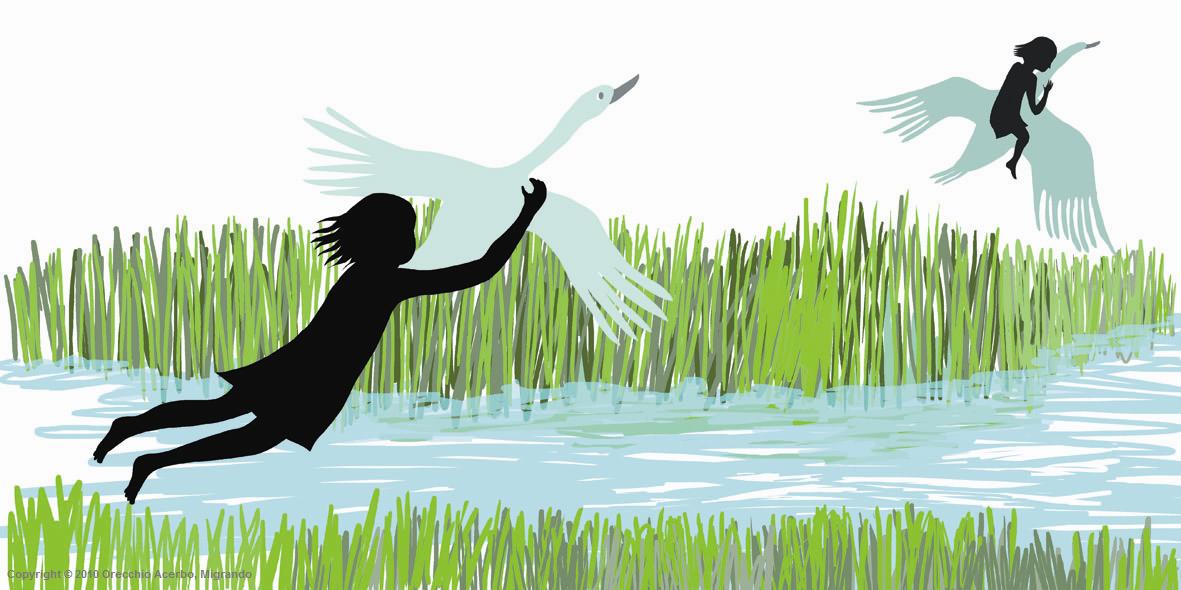
As many other wordless picture books, thanks to a skilful use of movie editing technique, Migrando as well follows the use of images in sequence. In small clips, Mariana Chiesa Mateos gets to illustrate with cleverness and sensibility, the story of a girl leaving with her parents for a trip: we don't know where she is directed, nor when she will come back, maybe she is leaving for a simple holyday, what we know is that she feels sad, that she would like to fly back on the wings of a swan
to find again someone she has left, maybe a grandmother, to hear her tell again of those times when, because of the war, men had abandoned their own country of origin to go elsewhere and try to make a new start. And so we can see the battle and soldiers dying, while frightened birds fly away from shots, and then we can see the big ships arriving and leaving, charged with their human load, only to put them down on the other side of the ocean. We can observe them, those emigrants full of hopes and just a few things, ready to look into the future, to build a house, a new life, all together.
We can see their intense eyes, the neckerchiefs over their hair, the babies covered in blankets like precious chrysalises. We can see them walking, full of faith, towards their future and we hope with them.
Then, in a sort of fusion, the first part of the book ends to leave space to present times: we rotate the book to meet the girl again, she is now a young woman, she is hugging her beloved and ready to leave. Once again we don't know where she is going, nor for how long, we only know she is sad because she is leaving behind those she loves. We know that she is going quite far away, as we see her climb onto an airplane. In that indefinite dimension that is space observed through a porthole, where everything is together incredibly small and incredibly big, the girl travels all alone, lost in her thoughts. But the world, down there, offers a new sight to observe: the ships are back again, no, it's not ships, it's boats, small, black boats, crowded with people;
at a short distance some light-hearted and unaware tourists are sunbathing on the beach. Someone finally sees the boats and comes to the help of those who are jumping into the sea. But this time it's the police that welcomes the shipwrecked once they step on the sand, a mother covers her son's eyes so he doesn't see the scene, others remain impassively on their sunbeds. The new emigrates will be held in a refugee camp fenced round with barbed wire, places they would like to escape to follow their dream of freedom. We don't know what their destiny will be, after all this is a piece of history that develops under our eyes, day after day.
As for me, I just hope they can find a better welcome than the one we see on the news every day.
If it's true that we are a population of emigrants, it's as well true that in the last fifty years we barricaded behind our little personal richness. Renouncing to well-being is difficult, though, if only we could stop a moment to think, we would know that we have no guarantee on what the future has in store for us; if only we could understand that maybe, one day, we could be emigrants again, then we should ask ourselves: how would we like to be received?