Pages

Showing posts with label Sélection Editeurs - Selezione Editori - Publishers Selection. Show all posts

Monday, 27 September 2010

All for one, one for all? No: All for All!

It rains, it’s a dull Saturday, damply meditative, what could I be talking about then if not POETRY!?!


Tutti per Tutti, by Julian Tuwim, Translation into Italian by Marco Vanchetti, project coordination by  Anna Niemierko. Graphic Projects by: 
Gosia Urbańska, Monika Hanulak, Gosia Gurowska, Marta Ignerska, Ania Niemierko, Agnieszka Kucharska – Zajkowska, Justyna Wróblewska. Orecchio Acerbo Editore, September 2010


My droll review:


What a nice, surprising book,
Are you waiting? Take a look!
With good Old Trallall-ild
you can make a happy child,
and for adults, good old boys,
birds are singing with great joy!
Everybody seems so happy,
they look beautiful and nappy:
all TV’s they have turned off
and nobody’s running off.
Trallallero, trallew,
what a nice, amazing new!


(Mr Trallallini, Graphic Project by Monika Hanulak)


Have I grown mad? Maybe... Or maybe this book is simply contagious! I just can’t get the  music of words out of my mind, any time I try to compose a sentence it comes out in rhyme, am I serious?

All right, I will try to be more polite though, my dear Orecchi Acerbi: you can’t publish a book like this and then pretend I can behave after reading it, this is what I call a fast one! This said, and given vent to my temporary folly, I shall move to a less humorous tone...

Julian Tuwim is a monument of Polish literature: born in Łódź in a family with Jewish origins, during World War II he emigrated to France first, then to Brazil and America last. He went back to Poland, where he died in 1953, only after the end of the big war.

If I had to tell you about Tuwim exhaustively a tome wouldn’t be enough, I therefore shall give you some basic information: in 1918, together with Antoni Słonimski, Jarosław Iwaszkiewicz, Kazimierz Wierzyński and  Jan Lechoń, he founded the poetical group called Skamander through which they tried to release Polish poetry from the prominently patriotic role it had up to that moment, to make it more comprehensible to common people by simplifying language and rejecting cross-references to mythology and figures of speech traditionally used. Tuwim uses experimental poetry, inserting typical common situations and expressions with frequent dialectic contaminations,  to grow away – more than anyone else did – from predominating mannerism. His most known writings are probably "Bal w Operze" (The Ball at the Opera), and "The  Locomotive", together with his wonderful poems for kids, our main object today.


(The Locomotive, graphic project by Gosia Gurowska)


Tutti per Tutti, at first published by the Polish Publisher Wytwórnia under the title "TUWIM. WIERSZE DLA DZIECI", won the Special Section of the Bologna Ragazzi Award devoted to poetry, in 2008.

The accomplishment obtained with this volume is enormous, in fact it contains seven graphic projects edited by different artists who therefore gave seven different interpretations of Tuwim’s imagination, with results that are distant as much as surprising. Sole junction point: his poems.


Here below you can find some examples, you can click on images to observe them better:

Project 1 - by Gosia Urbańska


(Alphabet) 

As you can see Urbańska, who illustrated four poems "Un Conto Complicato", "L'Alfabeto", "Gelo" and "Le Verdure"(1), prefers using materials on a white background, no matter if its scrap materials, collage or images obtained by using moulds immersed in colour.

(Frost)

Her images seem to pop out of the page, together with words changing body and font to support the lyric’s rhythm.

Project 2 - by Monika Hanulak


(Bambo)

Hanulak gives a definitely more pictorial interpretation – hers the versions of "La Rapa" cover image is obtained from this poem, "Micio", "Bambo", "Il Signor Trallallini" and "Scherzetto"(2) – with a taste that goes from retrò, obtained as well using old ruined papers as background and a two-colour print (La Rapa), to a modern tribal (Bambo) with a clean mark and backgrounds, to grotesque (Il Signor Trallallini, Micio and Scherzetto) that reminds me of some advertising campaigns from the 60’s and 70’s.

Project 3 - by Gosia Gurowska

(Two Winds)

Gurowska gives a markedly graphic interpretation of the three poems she was assigned, "Pettegolezzi d'Uccelli", "Due Venti" and "Locomotiva"(3). For all tables she uses a white background, images are extremely linear, a nice cross-reference with the text that results amplified and represented with great effectiveness.

Project 4 - by Marta Ignerska


 (Gabri)

Marta Ignerska, who moreover is the author of the beautiful L'Alphabet des Gens (People’s Alphabet) published this year by Le Rouergue has illustrated "I Due Gini", "Gabri", "Radio Uccello", "Gigio Sognatore" and "Sofia - Tuttoio"(4).

(Radio Bird)

Her mark, often blunt and softened, gives an almost dreamlike vision of the texts she has been assigned. Great, to my opinion, the representation she gave of Radio Uccello (above): strict chromaticism with red, black and strokes of shades of blue and green, at times almost unperceivable others more evident. Compared to other tables, here there are fewer characters; images are therefore easier to read.

Project 5 - by Ania Niemierko

(Click)

The original cover of the book, in the edition by Wytwórnia, was by Niemierko: it had been taken by one of the tables of the poem "L'Elefante Trombettoni". Hers as well the illustrations of "Cecco Bugiardino e Sua Zia", "Gli Occhiali", "Click", "In Aero-plano" and "L'Usignolo in Ritardo"(5).

(The Nightingale is Late)

Delicious those images with coarse-grained, at times scratched, backgrounds, a technique she sometimes uses for characters as well. Where Niemierko uses white backgrounds, as in "Click" (above) and "L'Elefante Trombettoni" for instance, heavy pencil marks or graphic signs intervene to trace evident points or zigzagging lines. Her characters, outlined with pronounced black or blue outlines, have rounded reassuring shapes. Colours, in this case as well, are very few: red, light blue, white, blue and black. Wonderful, to me, Click’s graphic!

Project 6 - by Agnieszka Kucharska – Zajkowska

(Mr Small and the Whale)

I am certainly wrong though, if I observe the backgrounds Agnieszka Kucharska–Zajkowska has used for her images, I have the clear impression I am looking at material surfaces’ pictures perfectly touched up, that almost give the impression of Moon’s surface. On those backgrounds, to which at times she adds touches of pencil and colour, she outlines characters with stereotyped features – as in "Il Signor Piccini e La Balena" (above and below) – or common objects and characters having a more graphical approach, almost recalling the rigid shapes of Lego – as in "Tutti per Tutti"(6).

(Mr Small and the Whale)


Project 7 - by Justyna Wróblewska

(Drizzle) 

By Justyna Wróblewska are the illustrations of "Pioggerellina" (above), "Prodigi e Stranezze" and "Va Tobia" (below) (7). She has created three completely different tables: "Pioggerellina" has a strong graphic approach, obtained by adding superimpositions of letters, graphic characters and murkiness effects, simulating thunders and lightning, to small touches of blue (very well done to my opinion); "Prodigi e Stranezze" has a mixed technique, reworked at the computer, to create a rightly surreal atmosphere, almost tropical-dreamlike; last "Va Tobia" where the collage composing the village’s road is enriched by simply sketched pencil drawings and italic writings, this ensemble confers to those images a simple, rural characteristic.


(Tobia Goes)


Enormous as well the enterprise of translating those poems into Italian, translation was made by Marco Vanchetti to whom goes all my appreciation for having obtained such a good result in such a complicated task.

Shortly, this is a real poetical anthology with many faces and strong irony, Tuwim’s irony of course: he, who was able to grasp the comic side of life in an historical moment where everything was tragically real.

In a cultural – or better artless – moment like this, deciding to publish poetry is an act of courage, something that goes against the tide, an act I personally welcome with great joy and with the confidence that, were we able to make others love poetry, it would regain all the strength it used to have in past times.


(1) "A Complicated Calculation", "The Alphabet", "Frost" and "Vegetables"
(2) ”The Turnip", "Pussycat", "Bambo", "Mr Trallallini" and "Little Joke"
(3) "Birds’ Gossip", "Two Wind" and "The Locomotive"
(4) "The Two Gino", "Gabri", "Radio Bird", "Gigio the Dreamer" and "Sofia - Iknowitall"
(5) "Elephant Bigtrumpet", "Cecco Liar and His Aunt ", "Glasses", "Click", "In Aero-plane" and "The Nightingale is Late "
(6) "Mr Small and The Whale" and "All for All"
(7) "Drizzle", "Wonders and Strangeness " and "Tobia Goes"

The titles above are my translation, with all possible mistakes! Sorry for that!


Copyright© text and images by Orecchio Acerbo 2010. Images have been reproduced with the permission of the Publisher, all reproduction is prohibited.

Thursday, 23 September 2010

Too Late?


Troppo Tardi, text by Giovanna Zoboli, illustrations by Camilla Engman, Topipittori Publishing, September 2010


You can find this post here, on Seven Impossible Things Before Breakfast!


Copyright© text and images by Casa Editrice Topipittori 2010. Images have been reproduced with the permission of the Publisher. All rights reserved.

Monday, 26 July 2010

L'Herbier by Emile Vast


L'Herbier, by Émile Vast, MeMo Publishing House, July19th 2009


There are books I've been wanting to write about before, more in-depth, but a variety of circumstances didn't allow me to, at least until now. I therefore will take my time, in these last July's days, to post little updates that I hope you will find of interest.

This morning I would like to shortly tell you about this text, that was published about a year ago already, by  MeMo Publishers in Nantes, if you don't know them already I invite you to take a look at their amazing catalogue.

As the title already explains, this book is an Herbarium: a small compendium of medieval inspiration, even though it's not purely a scientific booklet, dedicated to European leaf trees. It's a little treasure of style, composition and graphics. On its double pages we can see: on the left the leaf's silhouette complete with its description, on the right a full page illustration showing the tree branch picturing the different stages from gem, to flower and fruit. The sober and elegant style recalls Japanese art, which reflects as well in the careful and delicate use of colour.

It's a picture book where we can rediscover, together with more practical notions such as the use of wood obtained by the various trees, mythological anecdotes. The stories told are extremely short, no more than three lines, and they make you want to start searching old books about legends and myths. It's tales that make you ponder about all we loose every day, by taking the distance from nature and roots, no matter if it's the trees' roots or ours as they are inextricably tied the ones with the others, as this beautiful books makes us understand.

It was not a case if L'Herbier has obtained, during the last edition of the Bologna Children's Book Fair, a very well deserved mention amid non-fiction books. Here below is the jury's motivation:

"Emilie Vast has created an authentic, scientific herbarium. Hers is a clear, almost stark, style infused with poetry. We are shown the leaves of European species and at the same time learn much about Art Nouveau. We see how Western culture was, and remains, imbued with Japanism and how blending the two can produce exquisitely spare illustrations. Each plate is a typographical pearl, uncluttered and austere. Yet the herbarium also alludes to the enormous complexity behind the art of classifying the natural world. As well as recognizing plant species, children here learn respect for the environment around them." (source the Book Fair official website: http://www.bookfair.bolognafiere.it/en/boragazziaward/vincitori#non_fiction)

What else can I tell you? The book has been published in Italian as well, last June, by Salani Publishing Company (if I'm not wrong). I have tried to find an English version but apparently there is none yet, please DO correct me if I'm wrong as I would be delighted to see it published in English as well. Same for Spanish!?!

You can read some interesting reviews about this book, in French, on the following pages:

Lecture & Cie: http://leslecturesdemarie.free.fr/Litteraturedejeunesse/Recapitulatif/lherbierdemilievast.html

In case you wished to know better the book's author, these are her pages:

Site under construction - http://emilievast.com/
Blog on Myspace - http://blogs.myspace.com/emilievast 

This is it for now!

Tuesday, 6 July 2010

La Governante di Osmont

Regret or remorse, what's worse? An age-old problem and a very personal interpretation of life.

Not that Mr Tapinois had much choice as he got tangled, against his will, in a really big mess: he killed the housekeeper by mistake, while he was training for a duel.

Remorse therefore, and sense of guilt, get hold of the almost-young, almost-robust, almost-interesting and, above all, single Mr Tapinois!

This is the start of the new picture book, part of the collection Lampi, by Orecchio Acerbo.


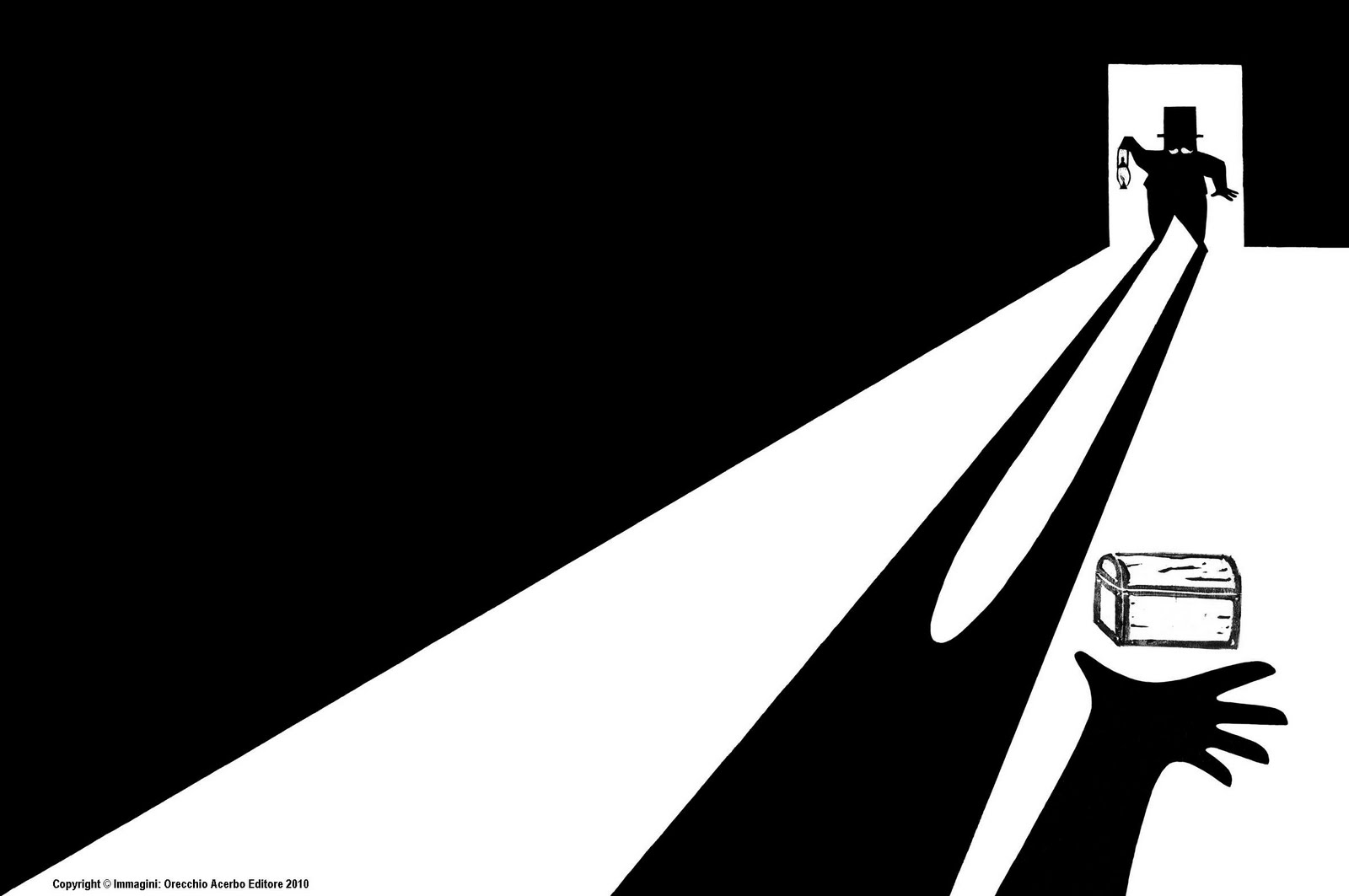
La Governante*, by Edouard Osmont, illustrations by Sara Gavioli, Publisher Orecchio Acerbo, July 2010


Is this a detective story? Not really. A Thriller then? Almost... Maybe a Surreal story is a better description, with a touch of humour noir, a pinch of grotesque and much irony. If these ingredients whet your fantasy then, from tomorrow, you can go at your bookshop and buy it!

La Governante is a perfect picture book for these days of suffocating hot: it'll freeze blood in your veins for an absolutely moderate price.... Now why don't we analyse together this beautiful volume? For this I shall have to use a more convenient tone though!

First of all two words about the author, whose ghost seems to have haunted the poor publishers until they were finally forced to produce the book!

Edouard Osmont, a.k.a. Blaise Petitveau, has become a ghostwriter of French literature between the end of the 19th and the beginning of the 20th century. About him we only know that he was a frequent visitor of Le Chat Noir, in Montmartre, together with a large group of artists and writers amid whom we find as well Alphonse Allais; we know as well that he contributed to magazines such as Le Rire, Le Sourire and Fantasio to which, amid others, were collaborating as well Henri de Toulouse-Lautrec (another well-known habitué of Le Chat Noir) and Pierre Henri Cami (another incredible writer, not a renowned one neither, even if he's more known than Osmont. Years ago, the publisher Sellerio, had printed his irreverent  Avventure di Loufock Holmès**, a clear parody of Sherlock Holmes).

Osmont therefore remains an enigmatic character, wind up in a mysterious aura and, up to today in a thick web weft as well. Luckily enough for us, Fausta and Simone have decided to remove this last one.

His writing is refined, captivating, with a nice sense of rhythm and implacable time scansion:

the housekeeper is killed (Bang! The shot roars in our heads)


and for poor Mr Tapinois a nightmare starts, what to do? Confess? Maybe he would be better hiding the body in a trunk...


From a veiled hint to absurd, though maintaining an elegant balance with reality, Osmont reaches the most paradoxical and unrestrained tones of absurdity.

The corpse of the housekeeper disappears (Bang! another shot that echoes in our minds)


but she is not ready to abandon Mr Tapinois yet: the housekeeper will reappear in a fun windmill of broken objects and increasing fear. Horror! Poor Mr Tapinois finds shelter nowhere, the corpse reappears, a threatening, prevailing presence, up to when...


Well, I won't be the one who gives away the end of the book!

The illustrations, by Sara Gavioli, are beautiful: edited with extreme care, always fitting, with a taste for retrò that marries well the text they refer to, and though they're always relevant. The enormous research Sara has made to obtain such a result is clear: we can see it surfacing in details, in unusual framings, in the careful décor. I'm thinking for instance of the pendulum clock, of the playing cards where she hides little information, of the use of silhouettes and the skilful handling of shadows.
The chromatic choice of the tables is absolutely right and, should it still be necessary, reveals furthermore Sara's original and unique talent. If you want to know something more about her, you can read the interview I made her last month: you'll find almost everything you shall like to know, including the most horrifying details! I'm kidding, of course...

What else could I say? Once again an audacious choice made by Orecchio Acerbo, a cultured, singular one, that goes against the tide. Once again my personal thanks go to Fausta and Simone for the excellence they keep bringing to our attention.


* La Governante means the housekeeper.
** Avventure di Loufock Holmès means Adventures of Loufock Holmès.

Saturday, 12 June 2010

Être Éditions - A support proposal and AMAZING PRIZES!

Hello everyone! Let me quickly signal a new appeal I just received from Être Publishing House: in substance Christian Bruel thanks everybody for their support, collaboration and books purchase.

Seen the situation, that is improving but yet not enough to avert the closing of the company, Mr Bruel proposes a couple of solutions in support of his business, I am copying them in image format here below


Solution A: foresees the dispatching of a cheque within June 30th, of no matter which amount, to support the publishing house. In change for this, for 30 people amid the supporters who will have participated, within September next there will be the draw of a book with dedication by the authors. The form is here below:


Solution B: foresees the dispatching of a cheque within June 30th, of 50 Euros or multiples, to support the publishing house. In change for this they foresaw several amazing prizes that I am listing in detail:

FIRST PRIZE: the whole collection of the 58 books published by Sourire qui Mord (1975-1995), plus all the 66 books published by Être (including some works that are almost impossible to find), for a total of 128 books.

SECOND PRIZE: the whole collection of the books published by Être Éditions, for a total of 66 books.

FROM THIRD TO SEVENTH PRIZE: ten big picture books by Être Publishing House, that is to say:
La Belle et la Bête, Où est Maman ?, Robert Pinou, Tous ses petits canards, Ma maman à nous, Attendre un matelot, Jeux étranges, Mama Sambona, Un drame bien parisien, Ne désespère pas, Gilbert.

FROM EIGHTH TO TWELTH PRIZE: the six picture books from the collection named « l’étrangeté », that is to say:
Margot veut lire, Cette histoire avec la vache, Le petit canard et moi (Noël), Le petit canard et moi (jeudi), Robocoutro, L’âge du capitaine.

Here below the form:


Let me remind you again their contact information:

Être Éditions
56, rue Ramus
75020 Paris

e-mail:  contact@etre-editions.com 
internet site: http://www.etre-editions.com/

If you haven't done it yet, do subscribe the Facebook Group supporting Christian Bruel:


I end, as usual, by saying that


culture is freedom: let's fight for it!

Monday, 22 March 2010

La Coda Canterina - Topipittori


"La coda canterina", texts by Guia Risari, illustrations by Violeta Lopiz, Publisher Topipittori, March 2010.


Let's try to remember how many kind of tails we know: there's the dog's tail, always ready to waggle; the cow's tail, that sometimes has a funny tuft at the end; the noble and luxurious horse's tail; the beaver's tail, flat and rounded, just like a scull; the squirrel's springing tail, always perfectly combed; the lion's tail, with a small mane at its edge; the cat's tail, that blows like a could ready to pour rain when the cat is hungry.


Well, for all the tales you'll be able to remember, I am sure that none, and I mean none, will ever be like this tail.


Why? There are at least three good reasons: the first is that this tail belongs to a child; the second consists in its length that equals earth's circumference; the third reason is that this tail sings with a heavenly voice, it sings so well that it would bewitch everybody, you too!

But let's start from the beginning: one morning a boy wakes up but he's not alone anymore, he is in company with a tail, his tail. The night before it wasn't there and now, here it is, firm at its place. The boy tries to hide it at first, without success, he then tries to drawn it in the bathtub but with no result. The tail starts to produce noise, at the point that the boy's parents end up breaking into the bathroom and discover the mystery. Oh my God, a tail! Worse: a singing tail! A cheeky tail that doesn't obey mom and dad's orders.

What to say? This is an awful, awkward, perturbing situation.

If you lived as well "in un paese minuscolo, così piccolo che il nome era più grande del paese"*, then you would know that you can't keep a secret too long. Much better involve also the other inhabitants then, not to afford the situation alone, who knows, maybe somebody could find a resolution to the problem.

No inhabitant of the village sees the tail as a deformity, it's more an inconvenient they want to get rid of: it's a problem that needs a resolution to be found all together. This is why, when someone suggests pulling the tail, the whole village is ready to help.


It's a fun picture book, surreal, that unties (this is really worthy saying) around an unusual protagonist like only a tie singing old Russian folk songs can be. This book has an old-fashioned taste from some point of view, starting with the sing-song the tail is singing, to end with the tiny-winy village, where everybody knows each other and help out; it's also a bit rural, for that strong sense of community that recalls life in the old farm-yard houses of the beginning of the twentieth century. Though nothing makes us understand if this is true as this is, at the same time, a perfectly modern story.

Guia Risari is very good at measuring little hints of magic, with a good amount of ironic and amused smile, mixed with the more concrete reality of the little village portrayed in its typical dynamics. A nice text, pressing, with a cultivated language. The illustrations by Violeta Lopiz, all played around a very simple chromaticism (white, black, different shades of grey and red) and a mixed technique, are wonderful. Her characters so well defined and recognizable go with the tale underlying the crescendo of the urgency, emphasized by the text's rhythm. The plate where the boy's parents are portrayed in foreground, once they get to know about the problem, is simply stunning.

This book is a beautiful journey: the fellow-countrymen's journey, pulling the tail till they go round the world, and our journey as, page after page, we discover what can't be seen.


Copyright© text and images by Topipittori 2010. Images have been reproduced with the permission of the Publishing House.


*"in a tiny village, so tiny that its name was bigger than the village itself"

Monday, 8 March 2010

Two Picture Books from Sarbacane

Today I shall introduce two new picture books published by Sarbacane respectively in January and February: "Coline" and "L'étrange projet de Monsieur G.".


Coline, texts by Alex Cousseau, illustrations by Chiaki Mijamoto, Editions Sarbacane, Jannuary 2009


Coline is a story about the friendship between a swallow, Coline, and Youyou, the turtle.

The two friends are inseparable, they happily play hide and seek on the beach, but autumn is incumbent and Coline starts feeling a strong instinct to abandon the country to migrate south. Youyou feels so sorry, she can't stand the idea to loose her friend, even if she knows that one day Coline will come back.

What could she do then? Maybe she could take a little souvenir of her friend, to warm her heart up during the long winter? Maybe a small feather, that smells of her, but will one feather be enough? Maybe two would do better than just one... Pushed by the wish to keep her friend close to her, Youyou doesn't fully understand what she is doing: poor Coline, who was so happy for the upcoming departure, will be quickly left featherless and she won't be able to leave as she had planned. Why, why did my dearest friend do this to me? She will ask herself. Youyou will have to find a solution to for the damage she has caused, and maybe she will as well find a way not to separate from her darling friend.


The power of friendship and the sadness caused by abandonment are the two topics that characterise this picture book for younger kids. The feeling of possession that Youyou feels doesn't allow her to immediately understand the hill she's doing to her friend and, maybe, in every friendship there is a moment like this, when we grow older as well.

This story tender and melancholy teaches us that we can't just think of ourselves, of our feelings, on the contrary we should think of those we love, to protect them from our small or big selfishness as well. And if we do something wrong we should try to find a remedy for it, with the means we can count on and with pure heart.

As I was just saying, this is a lesson that is good at all ages, because friendship is probably the purest feeling we could ever feel, as it's not ruled by relative bonds, or from other impulse other than selfless love.

This little picture book, full of poetry, is the result of the collaboration between two artists quite new to children's literature but already widely credited. Alex Cousseau, who started his career in 2004, has published with l'Ecole des Loisirs, for Le Rouergue he has written novels for kids and teenagers, and now Sarbacane publishes this picture book. His picture book titled "Dans moi', illustrated by Kitty Crowther, has been published in Italy by Topipittori Pub. House.     Chiaki Miyamoto, born in Osaka, lives in France since 2000, in 2003 she gets her degree at Emile Cohl's School in Lyon where she still lives nowadays: she has published several picture books with Gallimard Jeunesse, Belem, Nathan and Milan.

Of this book I have admired the gentleness and the sensibility of both, author and illustrator, dealing with the themes of friendship, touching the deepest reasons that lead us to behave incorrectly at times but also underlying e importance of opening mind and heart, in the effort of understanding the reasons of other people.

The illustrations, in their essential simplicity, enter the story quietly, to win readers' attention with the sober and soft lines and the bright colours.

From three years old on.


L'étrange projet de monsieur G., text and illustrations by Gustavo Roldan, translation from Spanish by Jacques Fuentealba, Editions Sarbacane, February 2010


Le me start by saying that, in this book, there is no reference to our Mr G. (Il Signor G. a.k.a Giorgio Gaber). Even if maybe, Gaber himself, would have appreciated its message, the surreal setting and that vein of madness, if madness is the right word, that animates this Mr G.

But let's start from the beginning!

Gustavo Roldan lives in Barcelona, and this could partly explain the flowery taste of some of the illustrations of this book, but he was born in Argentina, and maybe from here come its boundless spaces.

His Mr G. lives in a small village in the middle of the desert. It's a desert where nothing happens, nothing grows, and everything seems to be motionless for good. Everything is dry and silent, an eternal moment, suspended, as if we were in one of those desert scenes of Sergio Leone's western movies. In this desert, Mr. G lives politely with his neighbours, they say hello, and they make sure that everything is all right...


Until, one day, Mr G has a queer idea.

Well, let's say a mad idea: he decides to plant a flower in the desert to "poner un poco de música en este lugar"!*

His wise neighbours know for sure that no flower can rise in the desert, and flowers can't make any music for sure, Mr G. must have grown a little mad. What will happen with the seed that has been planted? Will it grow? Will it sing? I shall let you find the answer yourselves.

The apparent playfulness of the book, with its illustrations and their slightly stereotyped and ludicrous côtè, the light lines and the white background, hide a very serious message: personal initiative, when it's devoted to improve human condition, can change also those situations that are apparently lifeless. Didn't a precious flower grow on Saint Exupéry's desert moon? Thus, maybe, even if we look like mad at other people's eyes, we can try to grow our own sounding flower in the desert and, if it ever blows, who will be mad then?

Idling won't help change things, therefore our Mr G., with his likely desperate gesture, starts a little civil revolution that will bring to an unexpected and welcome changement in his village. To each one of us his own choice: are we mad or wise?

This picture book, with the title "El Señor G.", has been originarily released by the newborn Publishing House A Buen Paso (it's the same publisher that released another little masterpiece: Papá Tatuado, produced in Italy by Orecchio Acerbo)


Copyright© text and images by Editions Sarbacane 2010. Images have been reproduced with the permission of the Publishing House.


* "bring some music in this place"

Saturday, 20 February 2010

Vorrei Avere - Topipittori


It’s very likely that the most imperfect creature God has ever created is man. Animals are, exactly, how they should be.

This picture book is a 'canticle' to animal world. 'Playing tag' in thirteen wonderfully drawn plates, words and images allow us to appreciate what surrounds us with new eyes.

It's children's eyes observing animals, admiring them: kids would like to possess their qualities, they identify themselves in animals' agility, in their feline spring, in their sharp sight dominating the world.

It's children's voices acknowledging themselves into animals, in an identity exchange that brings man back to its instinctual and remote origin. Because the tie children have with nature is deeply rooted and immediate. There is no need of particularly complex explanations: nature, with its mechanisms and cruelties, is perfectly understood and accepted.

And so someone would like to have:


"Le orecchie immense dell'elefante per intendere quel che dice il cielo" *


Or:


"La voce della balena che canta e si sente a un oceano di distanza" **


As the publisher explains very well, in the presentation of this text, it's:

"Un libro in cui la bellezza non è mai nominata, ma in cui tutto lascia intendere che è ad essa che tende la voce che lo percorre.
Un libro-preghiera, per dire che se il pensiero è laico, la natura no.
Lei è sacra." ***

Giovanna Zoboli's writing is supple, dry. It’s an essential language, where there is no space for useless embellishments, where every word stands out in all its possible meanings. Short sentences that re-echo in our minds while eyes get lost in the drawings. Writing is made richer in details and colours by illustrations, that emphasise word’s evocative power.

Simona Mulazzani is always able to give her characters particularly intense countenances, these are always central and centred, often characterised by strong pictorial references. I'm thinking for instance at the tiger's image, that reminds me so much of paintings from Le Douanier, Henri Rousseau, with its denser and richer strokes, alternated with lighter touches appeasing an otherwise more dramatic effect.

Finding these two artists together, in a new book, is a real pleasure. We're talking here of an artistic couple that is very well consolidated: in the past they received important recognitions such as the Andersen Prize, in 2008, for the Best book in 0-6 category with "Al supermercato degli animali". Other famous books by Giovanna Zoboli and Simona Mulazzani are: "Filastrocca ventosa per bambini col fiato corto" and "Anselmo va a scuola", always published by Topipittori.

To my opinion, there is another nice new: in fact "Vorrei Avere" will be published contemporarily in several countries. This kind of demonstrates what I was already affirming here regarding the importance of collaboration amid publishing houses.

In particoular "Vorrei avere" will be published, with different covers, by:

Éditions Sarbacane, in France
Peter Hammer Verlag, in Germany
Los cuatro azules, in Spain
Moon Won, in Chorea
to end with Mexico, for Tecolote Publishing House, even if the book will be available with a few days delay with regard to other countries.

Before leaving you I would like to ask: "And you, what would you like to have?"

If you ask me, I would like to have:


"Il colore della pantera di notte per confondersi nel buio."


"Vorrei avere", texts by Giovanna Zoboli, illustrations by Simona Mulazzani, Ed. Topipittori, February 2010.


A special thank you to Paolo Canton and Giovanna Zoboli for allowing me to publish the images in this post and for the gracious collaboration.


Copyright© text and images Topipittori 2010. Images have been reproduced by the permission of the Publishing house.


* "Elephant's immense ears to hear what the sky has to say"


** "The whale's voice that sings and can be heard at an ocean's distance"


*** "A book in which beauty is never mentioned, but where everything lets understand that it's toward beauty that the voice crossing this work tends to.
A prayer book, to say that if thought is secular, nature isn't.
Nature is sacred."

**** "Panther's colour at night to blur in the dark."

Monday, 15 February 2010

L'Albero di Anna - Orecchio Acerbo

"Nelle città di polvere e rumore,
io, per primo, annuncio l'arrivo della primavera.
In aprile si schiudono le mie gemme
e con identico slancio spuntano foglie e fiori.

Io sono un ippocastano." *


Already in the first lines of this picture book, we are projected in another dimension. The world appears different when seen from the branches of a horse-chestnut tree: seasons rotate with the change of its foliage, life runs in an almost suspended rhythm as who tells our story has lived a centenarian life, and days' frantic passage doesn't really matter to it.

Though this is not a horse-chestnut tree like others, it is not just the narrative voice of our story it is, first of all, a memory bearer. We might quite fairly ask ourselves: which kind of memories could a tree have? What could have touched a horse-chestnut tree, in the slow flowing of its life, at the point it decided to tell us about its remembrances?

Well, this horse-chestnut tree has lived all its life in a garden, at 263 Prinsengracht Street, in Amsterdam.

If this address still means nothing to you, then listen to its voice again:

"Io, l'ippocastano del giardino al numero 263 di Prinsengracht,
ho regalato ad una ragazza di tredici anni,
prigioniera come un uccello in gabbia,
un po' di speranza e di bellezza." **

Now the picture starts to be clearer but it's not well outlined yet, still we cannot understand what could be so important, in the memories it has so carefully kept for all this time.

With its undefined rhythm, the tree tells us we are in 1942: the world is shaken by a "terrible ill", ruled by unfair laws, people who once were normal now act like crazy. Those who are submitted to the new, tough, laws find no escape, they hopelessly try to find a way out: some through escape, others hiding away from the rest of the world.


(image temporarily unavailable)


"E' un lunedì, il 6 luglio del 1942,
quando arrivano nella soffitta della casa di Prinsengracht.
....
Nella sua cartella lei [che ancora non ha un nome] ha fatto scivolare
un piccolo quaderno di cartone molto prezioso: il suo diario,
ricevuto in dono per il suo tredicesimo compleanno..." ***

Before we will get to know her name, we will know about her feelings, her sensations, her ever changing and contrasting moods, we will know about her struggling. For the very first time, we will see our horse-chestnut tree through her dreamy eyes, glancing through her 'cage bars', longing for freedom, blue skies and seagulls flying in boundless space. We will first read about her perturbation while, looking through the tiny window of the attic, she perceives the world getting even more so miserable and naked, in feeling death looming over her. We will first see her participating, from her hidden corner, to the pains of the world: as there is no shut door that can stop these from invading everything.

It is once again Anne's voice, Anne Frank, that comes to us through different paths: filtered, this time, by the sensibility of two exceptional artists such as Irène Cohen-Janca and Maurizio Quarello. By twisting perspectives of such a well-known story, they succeeded in returning it to us even richer, more touching.

The stillness that holds the horse-chestnut tree is the same that imprisons Anne: obliged to look at each other, narrating subject and protagonist reveal themselves, their true nature, under our helpless eyes. There is no possible action they can do to change their condition, the only possible action lays in the power of view, last bulwark of freedom.

The tree is sick, it will certainly die, this is the reason that pushes it to tell us about what it witnessed. Anne is prisoner, she will be caught and transported in a much worse prison. Anne will die as well, we already know this.

So, why telling this story again? Does it tell us anything different? Nothing and everything I shall say: nothing because we already know Anne Frank's story, everything because the reason of life itself lies in experience, memory and witnessing.

The small sprout that will be saved from the horse-chestnut tree of 263 Prinsengracht Street will become a new tree, but not a tree like others: it will become the memory horse-chestnut tree.


(image temporarily unavailable)


"L'albero di Anna", texts by Irène Cohen-Janca, illustrations by Maurizio A.C. Quarello, translation from French to Italian by Paolo Cesari, Orecchio Acerbo Pub., 2010. Original text published by Éditions du Rouergue in 2009.


I wish every kid had this book in their bookshelves: it is a real masterpiece of poetry and images that will be very hardly paired. Irène Cohen-Janca's texts gently transport us through the story, with endless tenderness and no subsidence. The art of Maurizio Quarello reveals the story with vibrant sensibility, confirming the incredible talents and versatility of this artist.

I wanted to send a special thank you to the guys at Orecchio Acerbo for allowing me to use the images of this post and, once again, for bringing to Italy a masterpiece from beyond the Alps.


Copyright© text and images Orecchio Acerbo Publishing House 2010. Images have been reproduced with the permission of the Publishing House. Original text published by Éditions du Rouergue, 2009.


(image temporarily unavailable)


*"In the cities of dust and noise,
I, the first, announce Spring.
In April my gems open
and with identical impulse flowers and leaves sprout.

I am a horse-chestnut tree."


** "I, the horse-chestnut tree at 263 Prinsengracht Street,
have given a thirteen years old girl,
imprisoned like a bird in its cage,
a little hope and beauty."

 
*** "It's July 6th 1942, Monday,
when they arrive in the attic of Prinsengracht Street's house.
...
 
In her school-bag she [who still has no name] has slipped
a little hardcover note-book, it's very precious: it's her dairy,
she received it for her thirteenth birthday..."